Introduction
Have you ever seen what happens to a whole locality after a college is set up there? A peaceful area starts to get filled up with photocopying places, PGs, cheap eateries, and finally a Zomato delivery boy sitting in front of every second house. We may think that it is all about "student life," but take a step back and we will see that there is more going on here than just that.
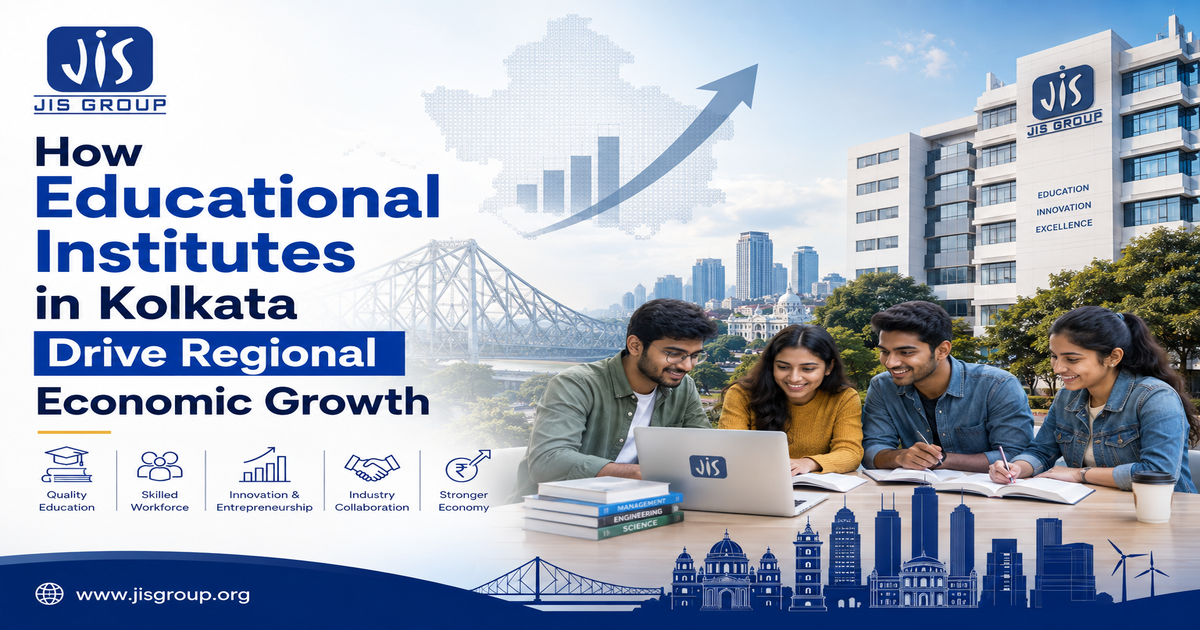
This is exactly the kind of ripple effect that makes educational institutes in Kolkata so much more than places where people go to get a degree. In many ways, they are one of the more consistently reliable sources of economic power for any region, providing job creation, demand, and future pipelines of talent extending well past campus boundaries. If you ever wanted to know why cities fight to bring quality institutions into their area, here’s your answer.
Let's break down exactly how this works.
Why Educational Institutions Matter Beyond Just Education
It's easy to think of a college's economic role as starting and ending with tuition fees and faculty salaries. In reality, the impact runs much deeper. Every functioning campus among the region's educational institutes in Kolkata creates demand for housing, food, transport, retail, and services around it and that demand doesn't disappear once students graduate, because new batches keep arriving every year.
This is one of the clearer reasons why colleges in Kolkata have become such consistent contributors to local economic activity, particularly in areas that were relatively underdeveloped before a major institution set up there.
-
Direct Employment Generation
The most apparent economic contribution would be direct employment of professors, administrators, laboratory technicians, and all those who work in order to manage the institution. Larger campuses among educational institutes in Kolkata with multiple departments and courses can employ hundreds, sometimes thousands, of people directly, creating stable, long-term employment in the surrounding area.
-
Indirect Employment Through Local Businesses
Besides direct employment, the existence of a campus creates a whole second economy as well. Hostels, PGs, food vendors, stationary stores, printers, public transport, and even tutorial centers are created only for students within that vicinity. The indirect employment provided through this avenue will end up being more in number than the direct employment provided by the institution.
-
Real Estate and Local Infrastructure Development
Infrastructure development is very common in the vicinity of educational institutes in Kolkata because there is a better road network, improved connectivity through transportation systems, and an increased demand for real estate as people move into or purchase property near these highly reputed institutions. This is bound to have positive effects on the larger region as well.
-
Building a Skilled, Employable Workforce
Perhaps the most significant long-term contribution is talent. Institutions offering strong academic programs produce graduates equipped to enter the workforce, start businesses, or pursue further specialization. Over time, this steadily raises the overall skill level of the regional talent pool, which in turn makes the area more attractive to companies looking to set up operations or expand.
-
Attracting Industry Investment Through Talent Availability
Companies don't just look at infrastructure or tax incentives when deciding where to expand they also look at whether there's a steady supply of skilled graduates nearby. A strong cluster of higher education institutions in West Bengal producing job-ready talent makes the region genuinely more attractive for companies considering setting up offices, R&D centres, or manufacturing units locally.
-
Strengthening Industry-Academia Collaboration
One of the more underrated economic contributions comes through industry-academia collaboration partnerships where companies work directly with institutions on research, live projects, internships, or curriculum design. These collaborations don't just improve student outcomes; they also give local industries direct access to fresh ideas, talent pipelines, and sometimes even applied research that feeds back into regional business growth.
-
Encouraging Entrepreneurship and Start-up Activity
Most organizations now encourage entrepreneurship through incubation centers and other such facilities. The graduates who decide to make their mark in the world by developing their business venture, as opposed to being an employee in any firm, usually go on to create more employment opportunities as well.
Why This Matters for Kolkata and West Bengal Specifically
Kolkata has a long, established history as an educational hub, and that legacy continues to shape the region's economy today. As more colleges in Kolkata expand into newer disciplines technology, management, healthcare, design the range of industries they support and feed talent into grows correspondingly wider. This diversification matters, because it means the region isn't economically dependent on just one or two sectors tied to education.
The broader network of higher education institutions in West Bengal also plays a role in reducing talent migration. When strong institutions exist locally, students are less likely to relocate entirely for education, and many of them go on to build their careers within the state rather than moving elsewhere permanently.
What Makes an Institution a Genuine Economic Contributor?
Not every institution contributes equally to this kind of regional growth.
The ones making a genuine difference tend to share a few common traits: strong placement partnerships that keep graduates employed, active industry-academia collaboration rather than occasional guest lectures, academic programs that evolve with actual market demand, and an industry-connected campus ecosystem that supports students, encourages innovation, and creates stronger links with the surrounding community.
This kind of ecosystem can bring together modern infrastructure, practical learning, career opportunities, industry exposure, and student-focused facilities. When these elements work together, an institution becomes more than a place for earning a degree—it becomes part of the economic and professional network of the region.
Looking Ahead
As Kolkata and the broader West Bengal region continue to grow economically, the role of educational institutes in Kolkata is only likely to become more significant, not less. Institutions that keep investing in relevant curricula, genuine industry partnerships, modern infrastructure, and opportunities that support both students and the surrounding community can continue to create value well beyond their campuses.
For students, this is also worth keeping in mind while choosing where to study. Institutions genuinely embedded in this kind of ecosystem tend to offer better exposure, stronger industry connections, and a more supported path from classroom to career than those operating in relative isolation.
Take the time to look at how connected a shortlisted institution actually is to its regional economy the placement partnerships, local collaborations, industry tie-ups, academic opportunities, and campus facilities. Strong educational institutes in Kolkata tend to be woven into this ecosystem, and it tells you a lot more about long-term value than a brochure ever will.
Choosing the right institution is an important decision, and you don't have to figure it all out on your own. Let us help you decide and get the guidance you need to move forward with greater clarity.
Frequently Asked Questions
-
How do educational institutes in Kolkata contribute to the local economy?
They create jobs directly through their staff, indirectly support local businesses such as housing and food service, create real estate developments, and develop a skilled labor force that entices more industrial investment.
-
What role do colleges in Kolkata play in reducing talent migration?
Having quality institutions locally enables the learners to choose from the best options without having to move. This makes it possible for many alumni to end up working within the state.
-
What is industry-academia collaboration, and why does it matter economically?
It refers to collaboration between firms and organizations in terms of research, internships, and curriculum development. This kind of collaboration allows industries within the locality to have exposure to new talents and innovations.
-
How do higher education institutions in West Bengal attract industry investment?
Availability of talent is an important factor for firms considering expansion. An established institutional framework that provides skilled individuals makes a geographical location very appealing for businesses to set up shop there.
-
Do academic programs need to evolve to stay economically relevant?
Yes. Programs that meet the true demands of the market enable graduates to remain employed, thus maintaining the economic contribution made by the institution to its region.
-
Why do educational institutes matter for regional infrastructure development?
Campus is usually responsible for creating a demand for better roads, transport links, housing, and local services, which help in developing the infrastructure in the area.